
The stock market has been going through a rough patch lately as investors worry about several things: interest rates, whether stocks are too expensive, and how well the economy is doing. Since December 6 last year, the main stock market index (S&P 500) has fallen 4.3%, while the interest rate on 10-year government bonds has gone up from 4.15% to 4.76%.
This drop in stock prices makes sense as investors process new information about the economy. A recent report showed more jobs were created than expected in December. This suggests the economy is doing well and might not need help from the Federal Reserve ("the Fed") in the form of lower interest rates. Right now, investors think the Fed might only lower rates once in 2025, possibly for the last time in this cycle. But these predictions can change quickly, just like they did throughout 2024.
It's normal for markets to go up and down, especially after two good years
 |
It's important to keep things in perspective. While it can be worrying to see your investments drop in value, remember that we're only a few days into the year and a lot can change. Last year also started with a brief dip before stocks went on a long upward climb. While past performance doesn't guarantee future results, long-term investors shouldn't panic over a few days of market uncertainty. In fact, these temporary dips might be good times to review your investment mix and make adjustments based on your long-term financial goals.
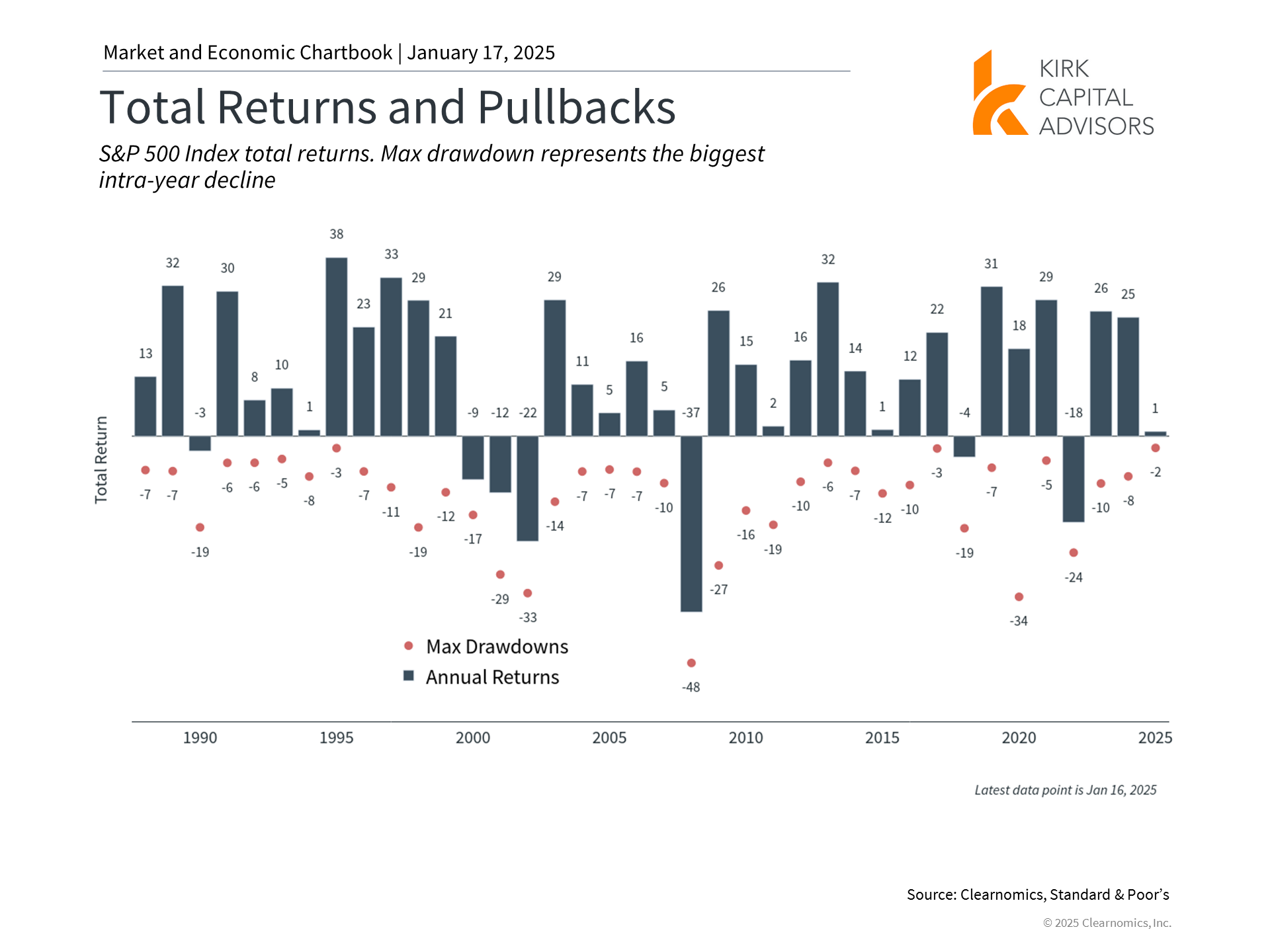
Keep in mind that markets have been quite steady over the past two years as stock prices reached new highs. As shown in the chart, the biggest drop in the S&P 500 last year was only 8%, which is smaller than usual.
History shows us that markets typically have several drops each year. These short-term declines usually recover quickly, so trying to time when to get in and out of the market often leads to worse results. That's why investors with longer time horizons usually do better by staying invested. People who kept their money in the market through recent challenges - including the pandemic, rising prices, interest rate increases, and global conflicts - have generally seen their investments grow.
The Magnificent 7 stocks have led U.S. markets higher
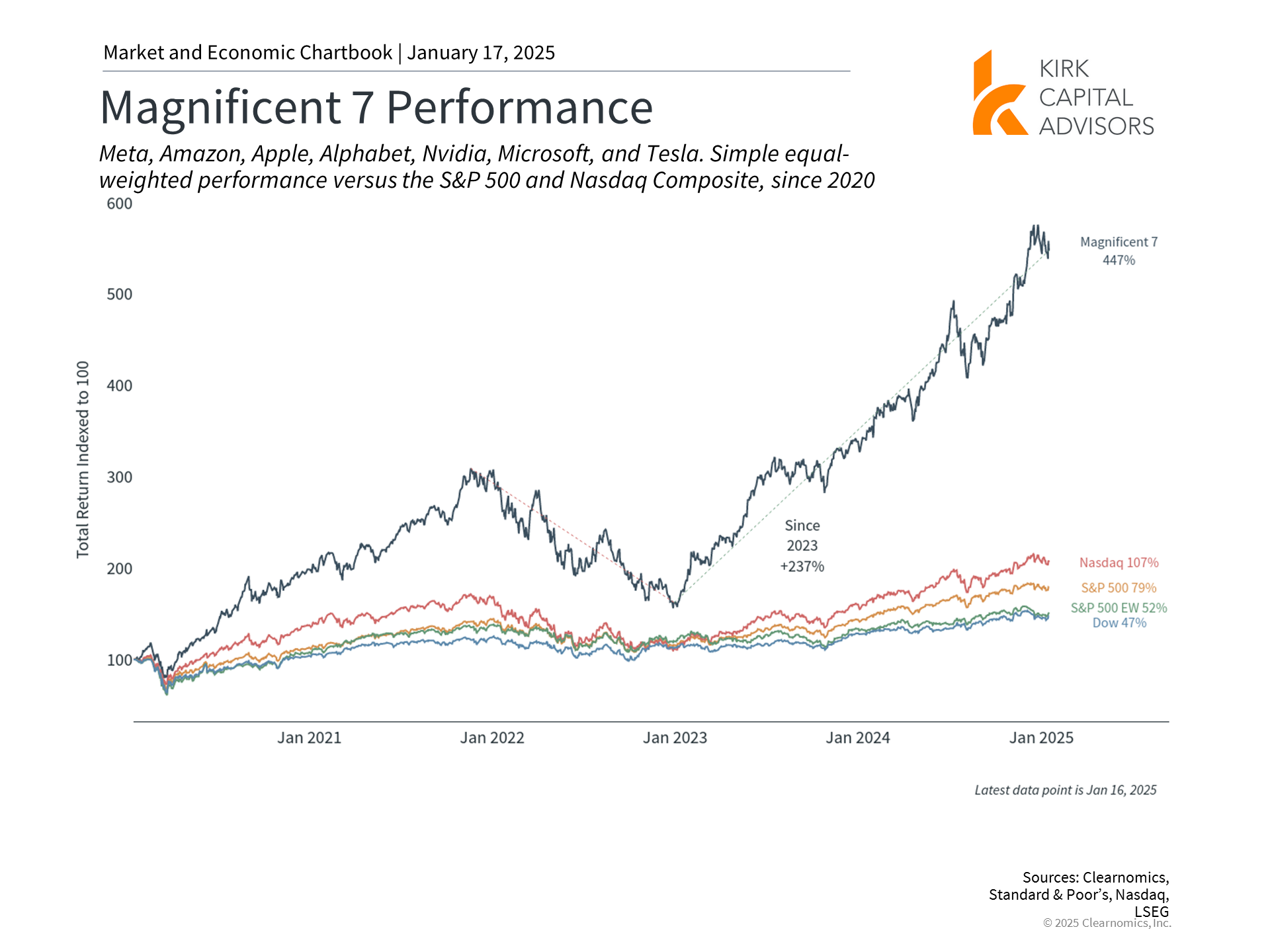 |
Many investors are wondering if the big gains in technology and artificial intelligence stocks can continue. People often talk about the "Magnificent 7" - a group of seven large tech companies that have benefited from AI developments. These companies have been driving the market's strong performance, with their stock prices rising 250% since early 2023 and nearly 500% since 2020.
While the Magnificent 7 and AI are important, it's wise to maintain a broader view. In 2022, when interest rates were rising and the economy was under stress, tech stocks fell the most. This happened because these companies' value depends heavily on future earnings. When interest rates go up, those future earnings become worth less today, which can cause stock prices to fall.
There's another risk to consider: because the main stock market index is weighted by company size, very successful stocks can become too large a part of your investment portfolio. This means you might have less variety in your investments than you want, or your portfolio might be too dependent on just a few stocks.
This isn't about predicting whether the Magnificent 7 will keep doing well or not. Instead, it's a reminder that successful investing isn't about making big bets on a few stocks. It's about building a diverse investment portfolio that matches your long-term financial goals, ideally with help from a financial advisor you trust.
Stock prices are high compared to company earnings
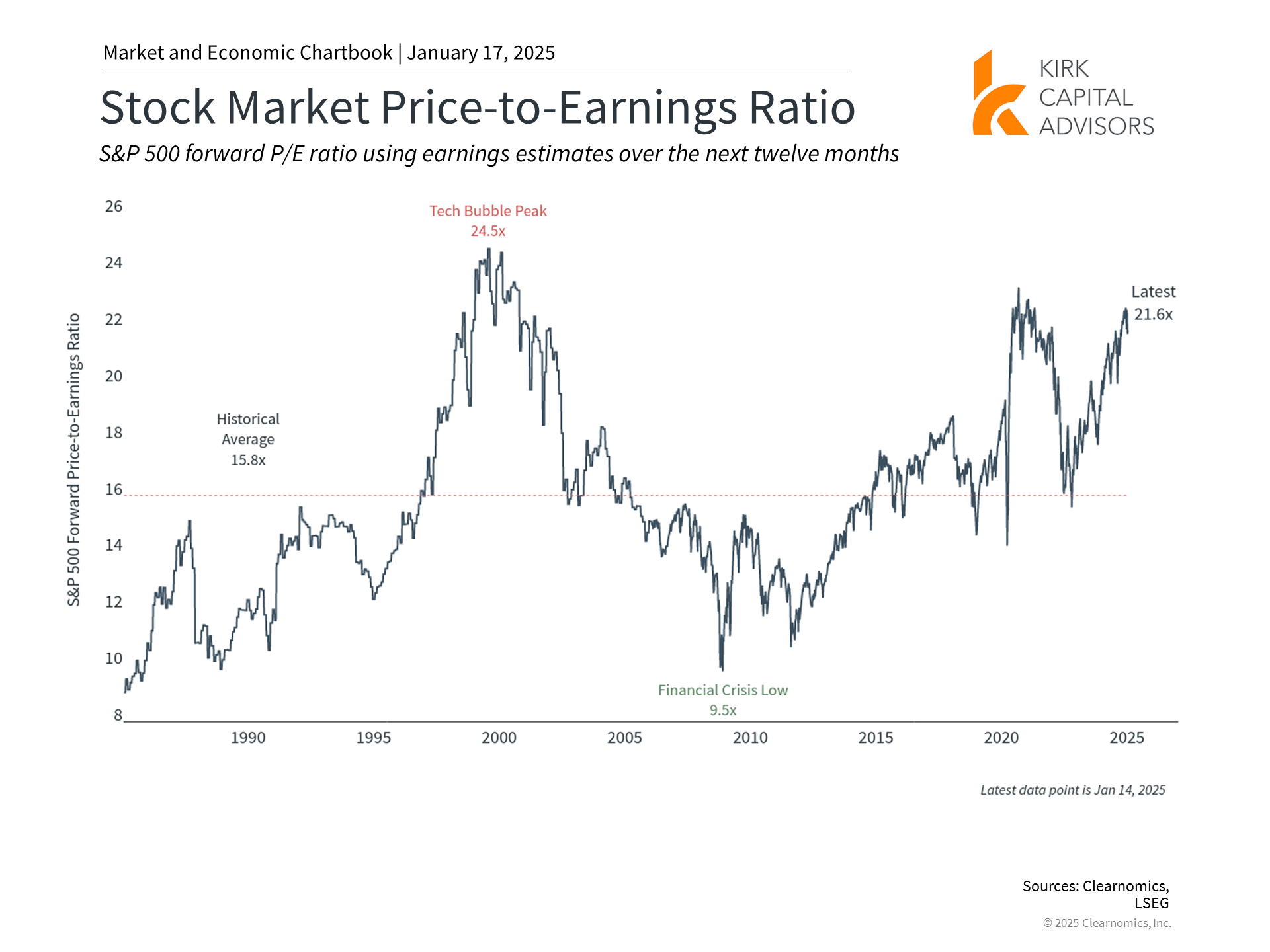 |
One big difference this year is that stock prices are much higher than usual compared to company earnings. The chart shows that the price-to-earnings ratio (which measures how expensive stocks are) for the S&P 500 is 21.5 times earnings - near its highest level in recent years and close to the record of 24.5 times during the dot-com bubble. Some investors worry we might be in another bubble, especially in AI stocks.
When the price-to-earnings ratio is high, it means investors are paying more for each dollar of company profits than they usually do. This might mean future investment returns could be lower, or that stock prices have gotten ahead of themselves. The key question is whether the economy and companies are fundamentally healthy, or if stock prices are built on shaky ground like in 2000 or 2008. Currently, the economy is growing steadily, jobs are plentiful, and the most popular companies are making good profits.
When stock prices are high, the answer isn't to avoid stocks completely. Instead, it's better to spread your money across different types of investments that can do well at different times. This might include investing in areas beyond tech companies, and in different types of stocks such as value stocks, smaller companies, or other investments that don't all move in the same direction. The key is to have an investment mix that fits your personal financial goals.
The bottom line? While stocks have had a rough few weeks, there's no need to make sudden changes to your investments. Focus instead on maintaining a balanced investment mix that can handle short-term market swings while helping you reach your long-term financial goals.